Vijit Veer Hooda
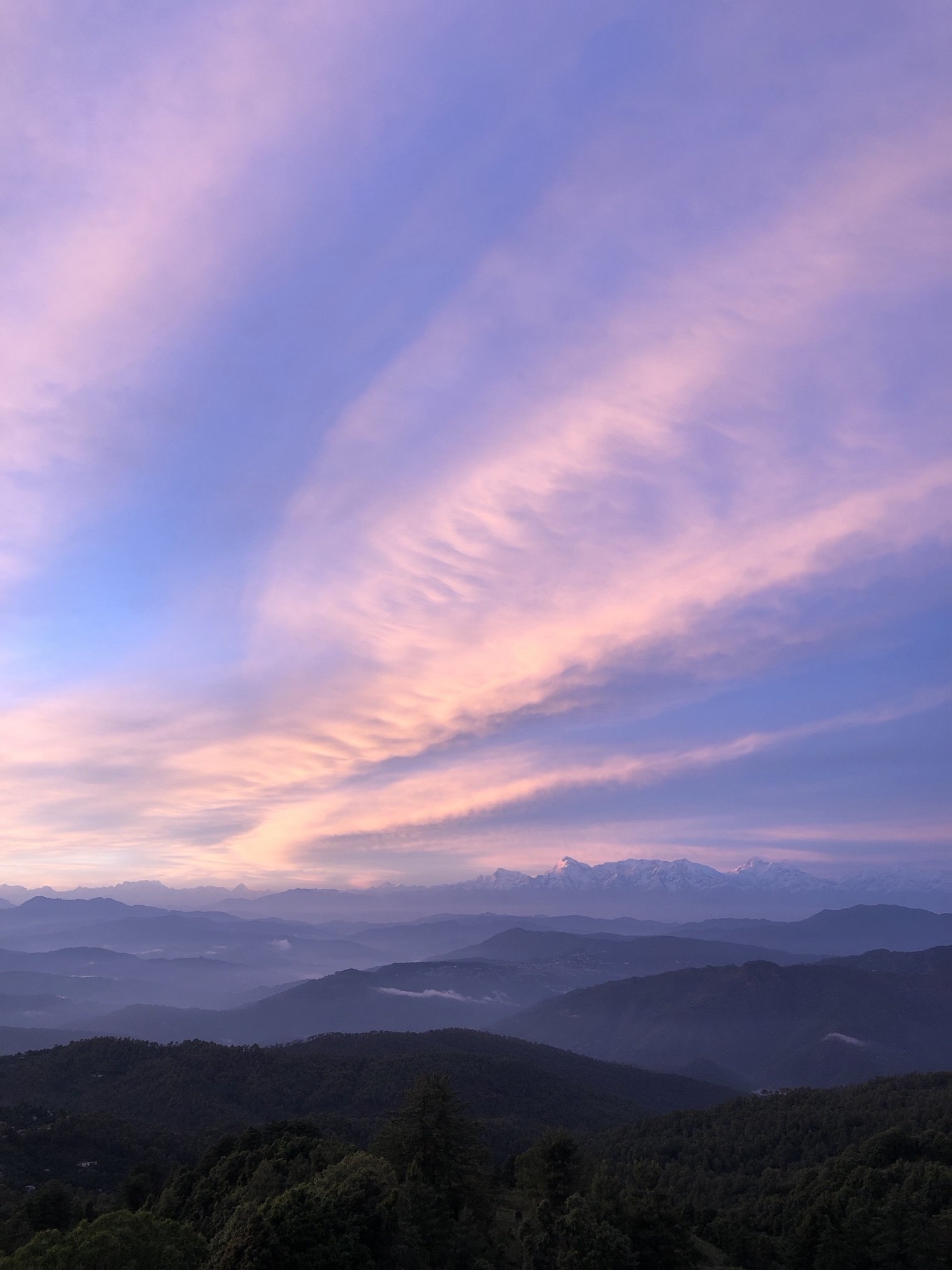
Photographed by Vijit Veer HoodaFrom his family home in Mukteshwar · Himalayas, India
One full of love and tragedy, Veer Hooda learned about life’s beauty and brutal abstraction at an early age.
Born into a loving, large, affluent family in India in 1985 to an artist mother and a respected businessman, Veer Hooda grew up seeing deep connection and community. Spending entire summers in the deep Himalayas, exploring the mountains as a child, filled the artist with a deep sense of nature and the context in which we fit into that scene as humans.
At home, Veer Hooda used his mother’s talent and influence to take a deep interest in the arts early in his life. His creativity took another turn after joining music school and eventually a rock band, where he played the drums, mostly covers from the Pearl Jam era; “Even Flow” is still one of his favourite songs. His first vocation, as a 15-year-old, was teaching drums. He was paid his first 20 dollars for that job.
Then came the early and sudden loss of his father, a central figure in his life and community. It affected the artist in a profound way. The abstract way in which life works became apparent, and the appreciation of the fragility of life became a central principle of his life. Enjoying it was the way forward.
Years later, that lesson returned.
When the pandemic closed the world, Veer Hooda found himself locked in his family’s Himalayan home for eight months. It was an incredibly hard time; life as he knew it was uprooted almost overnight.
He went from private jetting between Dubai and the Bahamas with his billionaire best friend to a life that cost somewhere around 20 dollars a month. For those eight months, he had only his dog, his mom and his sister near him.
Yet it also became a great spiritual awakening, a tuning in to a reality entirely different from the one he had known. After years of a busy, social life spent travelling the world, the solitude brought him back to himself.
He threw himself into nature and physical fitness: not the gym kind, the cutting-logs-every-evening kind. He spent entire days in the forest with his dog and a long machete, because of a leopard scare in the neighbourhood.
Despite that, every day he sat at the edge of some of the most beautiful mountains on earth, looking out over the Nanda Devi range, and meditated beneath a sky and a landscape beyond anything he could have imagined. Nature began to feel like the greatest art there is, and he had a front-row seat.
Somewhere in those quiet months he started unlearning a lot of what he thought he knew, and let his creative side do more of the talking. He came down from the mountains with fewer answers than he had expected, but with a much better idea of what truly mattered to him.
The pandemic gave him something else too: a slower pace, and he held on to it when he returned to everyday life. He set up a studio and started painting, painting the skies and mountains he had sat under, for hours on end, canvas after canvas. What began as a way to hold on to those months turned into hundreds of hours of painting and a studio slowly filling up with canvases.
It was a long way from where he had been. Before the mountains, there had been two decades of a very different life. He studied Business and Mathematics, then went on to work with some of the best finance firms in the industry. From financial services to private equity, to building his own companies and, of all places, diplomacy. It was a good life, a full one. Then, a few months before his daughter was born, he decided to go after what was truly important to him: becoming an artist. The story, he’d tell you, is only just starting.
The skyline traced from Vijit Veer Hooda’s photograph of the view from his family home in Mukteshwar · distances measured from the house
Join me in this journey, we’ll go places together.
— Vijit
Represented by
Gallery STEINER, Vienna